
Turning 40 in the UK brings many celebrations, but for personal finance enthusiasts, it marks a particularly poignant deadline: the final day you can open a Lifetime ISA (LISA) and access up to £33,000 in government bonuses. With the average age of first-time buyers now reaching 34 (DLUHC, 2024) and retirement planning often starting in one’s 40s, thousands of Britons find themselves confronting this arbitrary age barrier just as their financial planning becomes most urgent.
HMRC data reveals a telling pattern: LISA subscriptions peak at ages 38-39, with a frantic rush to open accounts before the deadline. In the 2022/23 tax year alone, over 85,000 individuals aged 38-39 opened LISAs, representing 42% of all new accounts. This “last-minute surge” demonstrates both the product’s appeal and the frustration of its age-based exclusion.
For the 15.3 million Britons aged 40-49 (ONS, 2024), the question isn’t merely academic—it’s financially significant. This comprehensive guide explores what happens to LISA strategy after 40, examines whether existing accounts remain valuable, and reveals superior alternatives for mid-life savers.
Chapter 1: The Reality Check – What Actually Changes at 40?
The Legal Framework: Age-Based Restrictions Demystified
Many over-40s harbour misconceptions about their LISA eligibility. Let’s clarify what the legislation actually states:
Before 40th Birthday:
- Can open a new LISA (until 11:59 pm on the day before the birthday)
- Can contribute £4,000 annually (until age 50)
- Eligible for a 25% government bonus on contributions
After 40th Birthday:
- ❌ Cannot open a new LISA (absolute cut-off)
- ✅ Can continue contributing to existing LISA until 50
- ✅ Still receive 25% bonus on contributions
- ✅ Can transfer between providers
The Birthday Timing Quirk
Your 40th birthday falls on June 15th? Your final opportunity to open a LISA is June 14th. HMRC uses exact dates, not “in your 40th year.” This catches out hundreds annually who mistakenly believe they have until their birthday.
The Existing Account Advantage
If you opened a LISA at 39, you would enjoy a unique 11-year contribution window (40-50). This creates what financial planners call the “compressed bonus period”:
Example – Sarah opens LISA at 39:
– Years 39-49: 11 contribution years
– Maximum contributions: £44,000
– Maximum bonuses: £11,000
– Potential growth (5% annually): £15,832
– Age 60 value: £70,832
Chapter 2: The Mathematics of Late-Stage LISA Contributions
The “Last Minute” Contribution Analysis
For those with existing LISAs, continuing contributions after 40 requires strategic calculation. The opportunity cost changes significantly in your 40s.
Scenario Analysis: Contributing £4,000 at Age 45
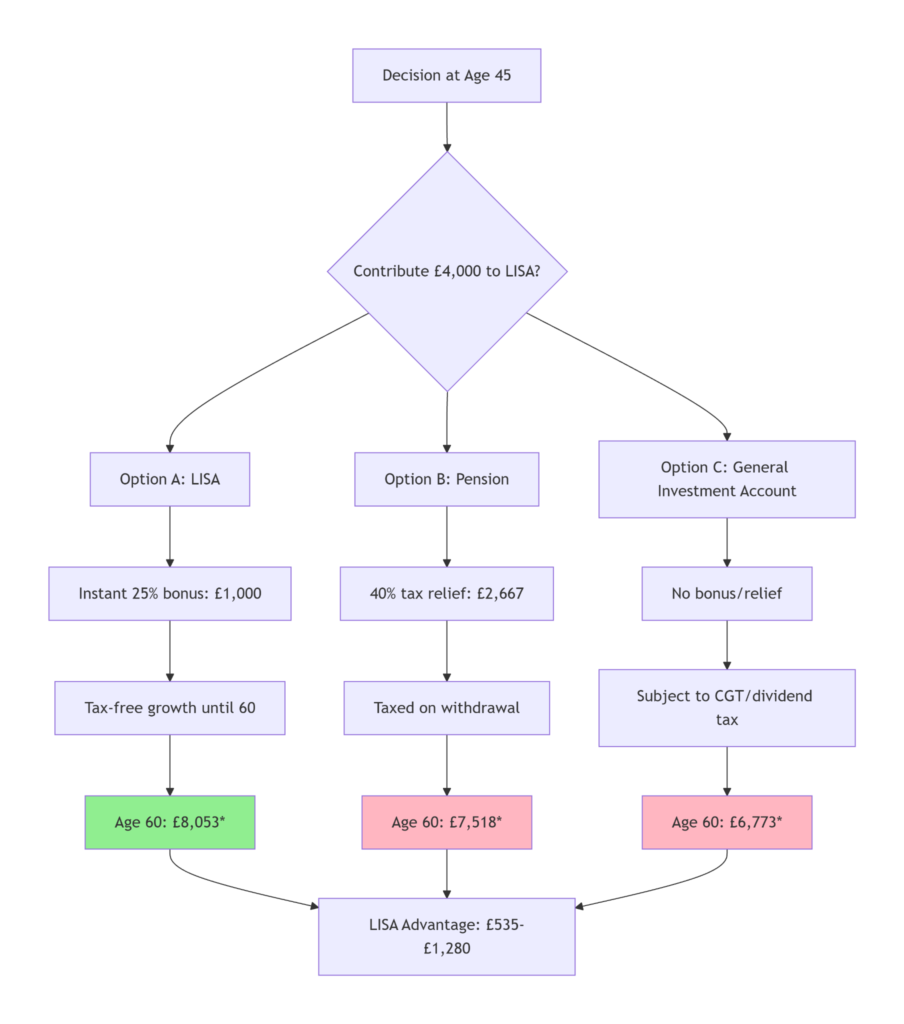
Assumes 5% annual growth, basic rate taxpayer in retirement
The Diminishing Time Horizon Effect
As retirement approaches, the LISA’s tax-free advantage competes with pensions’ earlier access:
| Contribution Age | Years to LISA Access | Years to Pension Access | Access Advantage |
| 40 | 20 years | 17 years (57) | Pension: 3 years |
| 45 | 15 years | 12 years | Pension: 3 years |
| 48 | 12 years | 9 years | Pension: 3 years |
| 49 | 11 years | 8 years | Pension: 3 years |
Key Insight: The closer you are to retirement, the more valuable early pension access becomes relative to LISA’s tax-free status.
Chapter 3: The First-Time Buyer Dilemma Over 40
The Growing Demographic Reality
With the average age of first-time buyers without parental help now 37 (rising to 41 in London), thousands approach their first purchase after the LISA opening window closes.
Regional Breakdown of First-Time Buyer Ages:
- London: 41 years
- South East: 38 years
- South West: 36 years
- Midlands: 35 years
- North: 34 years
- Scotland: 33 years
Alternatives for Over-40 First-Time Buyers
1. Help to Buy: Equity Loan (until March 2025)
- Eligibility: First-time buyers, any age
- Mechanism: 20% equity loan (40% London)
- Price cap: £600,000 (£450,000 London)
- Advantage: No interest for 5 years
2. Shared Ownership
- Eligibility: Household income <£80,000 (£90,000 London)
- Mechanism: Purchase 25-75% of the property
- Advantage: Lower deposit requirements
3. Retirement Interest-Only Mortgages
- For: Those approaching retirement
- Feature: Payments cover interest only
- Benefit: Lower monthly commitments
The “Bank of Family” Reality
For many over-40 first-time buyers, family assistance becomes crucial:
- 42% of first-time buyers over 40 receive family help (UK Finance)
- Average gifted deposit: £25,000
- Strategic approach: Combine family help with mortgage innovation
Chapter 4: The Retirement Focus – LISA vs Pension After 40
The Tax Efficiency Comparison for Over-40s
Higher Rate Taxpayers (40%):
£10,000 retirement contribution:
– SIPP: Costs £6,000 (gets £10,000 invested)
– LISA: Costs £10,000 (gets £12,500 invested)
– **Difference:** SIPP saves £4,000 now vs LISA’s £2,500 bonus
Net position after basic rate tax in retirement:
– SIPP: £8,500 (after 20% tax)
– LISA: £12,500 (tax-free)
– **LISA advantage:** £4,000
Basic Rate Taxpayers (20%):
£10,000 retirement contribution:
– SIPP: Costs £8,000 (gets £10,000 invested)
– LISA: Costs £10,000 (gets £12,500 invested)
– **Difference:** SIPP saves £2,000 now vs LISA’s £2,500 bonus
Net position after basic rate tax in retirement:
– SIPP: £8,500
– LISA: £12,500
– **LISA advantage:** £4,000
The Access Age Consideration
With pension access age rising to 57 in 2028, the gap between pension and LISA access narrows:
Current ages (2024):
– Pension access: 55 (rising to 57)
– LISA access: 60
– Difference: 5 years (reducing to 3)
For a 45-year-old:
– Pension access at: 57 (12 years)
– LISA access at: 60 (15 years)
– **Access advantage:** Pension by 3 years
The “LISA First” Strategy for Existing Holders
If you have an existing LISA and are deciding between additional contributions:
Priority order for over-40s:
1. Workplace pension to a maximum employer match
2. Existing LISA to £4,000 annually (if basic rate taxpayer)
3. SIPP for additional retirement savings
4. ISA for flexibility
Chapter 5: The Superior Alternatives – What Beats LISA After 40?
Alternative 1: Maximising Pension Contributions
The Annual Allowance Advantage:
- Standard allowance: £60,000 (2024/25)
- Carry forward: Unused allowance from the previous 3 years
- Potential contribution for over-40s: Up to £240,000 in one year
The Tax Relief Reality:
Higher rate taxpayer, age 45:
– £10,000 pension contribution
– Tax relief: £4,000
– NI savings via salary sacrifice: £1,380
– **Total saving:** £5,380
– Effective cost: £4,620 for £10,000 invested
Alternative 2: The Flexible ISA Strategy
Benefits Over LISA:
- No age restrictions
- No withdrawal penalties
- £20,000 annual allowance (vs LISA’s £4,000 within that)
- Same tax-free growth
- Immediate access if needed
The ISA Compounding Advantage:
text
Starting at 40 with £10,000 annual ISA contribution:
– By age 60: £347,192 (at 5% growth)
– All withdrawals are tax-free
– No access restrictions
Alternative 3: Venture Capital Trusts (VCTs) & EIS
For sophisticated investors over 40:
- VCTs: 30% income tax relief (minimum 5-year holding)
- EIS: 30% relief, loss relief, CGT deferral
- Risk: Higher, but tax benefits are substantial
- Suitability: Only for those comfortable with higher risk
Alternative 4: Property Investment via Limited Company
For those considering property as a retirement supplement:
- Mortgage interest is fully deductible
- Profits taxed at corporation tax rates (25% from April 2023)
- Extract profits via dividends or salary
- Consideration: Regulatory burden and market risk
Chapter 6: The Transfer Dilemma – What to Do With Existing LISAs
The Transfer Options Analysis
If you hold a LISA opened before 40, you face strategic decisions:
Option 1: Continue Contributions (Until 50)
- Maintains bonus eligibility
- Lock-in until 60 (or property purchase)
- Best for: Those certain of retirement use
Option 2: Transfer to ISA
- Process: Withdraw with 25% penalty, reinvest in ISA
- Maths: 6.25% loss of your contributions
- When sensible: If needing access before 60 and penalty < alternative costs
Option 3: Hold Without Further Contributions
- Money continues growing tax-free
- Access at 60 (or property)
- Minimal ongoing management
The “Penalty Break-Even” Calculation
To determine if penalty withdrawal makes sense:
Required alternative return = (Penalty % / Years to 60) + Alternative return
Example – Age 45, 15 years to LISA access:
– Penalty: 6.25% of contributions
– Annualised penalty cost: 0.42%
– If alternative investment returns >0.42% more than LISA, consider withdrawal
Chapter 7: The Couples Strategy – Maximising Household Benefits
The Age Disparity Advantage
Mixed-age couples can strategise effectively:
Scenario: Partner A (38), Partner B (42)
- Action: Partner A opens LISA immediately
- Maximum household bonus: £11,000 (if Partner A contributes 11 years)
- Property purchase: Can combine bonuses if both are first-time buyers
The Intergenerational Planning Opportunity
Parents over 40 can assist children’s LISAs:
- Gift money to adult children for LISA contributions
- Child receives 25% government bonus
- Potential inheritance tax advantages
- Limit: £3,000 annual gift allowance (£6,000 if unused previous year)
Chapter 8: The 2024 Economic Context – Inflation, Rates and Regulations
Interest Rate Environment Impact
With the Bank of England base rate at 5.25% (March 2024):
- Cash LISAs offer 3.5-4.25%
- Inflation at 3.4% creates minimal real returns
- Implication: Stocks & Shares LISA likely better for retirement-focused over-40s
The Abolition of Lifetime Allowance (2024 Budget)
Game-changing for over-40s:
- No tax charge on large pension pots
- The maximum tax-free lump sum remains £268,275
- Impact: Makes pensions more attractive for wealthier over-40s
Frozen Tax Thresholds Until 2028
- Personal allowance: £12,570 (frozen)
- Higher rate threshold: £50,270 (frozen)
- Result: More over-40s pushed into higher tax bands, enhancing pension relief value
Chapter 9: The Psychological Aspects – Behavioural Finance Insights
The “Sunk Cost” Fallacy
Many over-40s with existing LISAs feel compelled to continue contributions because they’ve “already started.” Behavioural economists call this the “sunk cost fallacy.”
Rational approach:
- Evaluate current contributions independently
- Ignore previous contributions in decision-making
- Consider whether you’d start today if new
The “Loss Aversion” to Penalties
The 25% withdrawal penalty triggers disproportionate psychological pain:
- Actual loss: 6.25% of your money
- Perceived loss: Often feels like 25%
- Result: Many hold LISAs sub-optimally to avoid penalty
The “Deadline Effect”
The age 50 contribution deadline creates artificial urgency:
- Leads to rushed decisions at 49
- May cause overallocation to LISA vs better options
- Antidote: Plan contributions from 40, not 49
Chapter 10: The Action Plan – A Decade-by-Decade Guide
Ages 40-44: The Strategic Assessment Phase
Annual Checklist:
- Review existing LISA performance
- Compare with pension contribution benefits
- Assess property purchase plans
- Calculate retirement income projections
- Consider partial LISA contributions if beneficial
Ages 45-49: The Maximum Contribution Phase
If keeping LISA:
- Maximise £4,000 annual contributions
- Ensure investments match the timeline
- Coordinate with pension contributions
If abandoning LISA:
- Calculate penalty vs opportunity cost
- Execute transfer in April (new tax year flexibility)
- Reinvest in the optimal vehicle
Ages 50+: The Growth & Transition Phase
Actions:
- No further LISA contributions allowed
- Monitor performance vs alternatives
- Plan a withdrawal strategy for age 60
- Consider partial withdrawals to manage taxes in retirement
The Five-Year Review Cycle
Every five years, over-40s should:
- Recalculate retirement projections
- Re-evaluate LISA vs alternatives
- Adjust investment strategy for changing timeline
- Review life circumstances and goals
- Optimise overall financial plan
Conclusion: Finding Value Beyond the Age Barrier
The LISA’s age restriction represents one of personal finance’s great ironies: just as many Britons achieve the financial stability and clarity to benefit from structured savings, the government withdraws one of its most generous incentives. Yet this closure reveals a more profound truth: sophisticated financial planning in your 40s transcends any single product.
The Three Core Realities for Over-40s:
- The LISA isn’t dead if you have one – Existing accounts remain potent tools, particularly for basic rate taxpayers planning retirement incomes below £50,000
- Pensions usually win for higher earners – The combination of higher relief, earlier access, and employer contributions typically overwhelms LISA benefits
- Flexibility has increasing value – As life complexity grows in your 40s and 50s, the ISA’s accessibility often outweighs LISA’s restrictions
The age 40 LISA deadline, while frustrating, serves as a valuable financial milestone—a prompt to reassess, recalibrate, and often discover that more powerful vehicles await those willing to look beyond a single product. In the words of financial planner Sarah Coles: “The best savings vehicle isn’t the one with the cleverest marketing or even the highest bonus—it’s the one that fits your actual life, not the life you imagined at 25.”
For Britain’s over-40s, that life is richer, more complex, and ultimately more financially promising than any age-restricted account could accommodate. Your best savings years aren’t behind you—they’re just taking a different, potentially more profitable, path.
Disclaimer: This article represents financial information, not personal advice. Tax rules, pension regulations, and product details change regularly. The LISA age restrictions, pension access ages, and tax thresholds are subject to government policy changes. Figures based on March 2024 data and assumptions. Past investment performance does not predict future returns. The value of investments can fall as well as rise. Always consult official government guidance and consider speaking with a qualified financial adviser before making financial decisions. Individual circumstances vary significantly, particularly for those over 40 with complex financial situations.